
The real estate profession is changing—not only in Trinidad and Tobago, but across the Caribbean and internationally.
Today’s clients are more informed. Financial institutions have strengthened compliance requirements. Property transactions have become more sophisticated. Technology has transformed the way buyers search, sellers market, and investors evaluate opportunities. Yet despite these changes, one question continues to surface:
Are we preparing our real estate professionals to meet modern industry standards?
I believe the answer lies in education.
For many years, real estate has often been viewed as a profession that anyone can enter with little or no formal preparation. While practical experience remains invaluable, experience alone is no longer sufficient in an environment where legislation, ethics, risk management, customer expectations, digital marketing, and property investment strategies continue to evolve.
Professional industries do not grow by chance—they grow through standards.
Whether we consider accounting, engineering, banking, nursing or project management, each profession has recognised competency frameworks that define what practitioners should know and what they should be able to do.
Real estate should be no different.
The Global Shift Towards Competency
Across the world, employers are increasingly recruiting based on demonstrated competencies rather than simply years of experience.
The International Labour Organization (ILO) has consistently promoted competency-based education and training as a critical driver for workforce productivity, employability and sustainable economic development. Competency-based systems ensure that individuals can perform effectively in real workplace environments rather than simply possessing theoretical knowledge.
This philosophy is now embedded throughout CARICOM’s Technical and Vocational Education and Training (TVET) framework.
Why the CVQ Matters
The Caribbean Vocational Qualification (CVQ) was developed to establish consistent occupational standards across CARICOM. Rather than measuring how long someone has studied, the CVQ measures whether an individual has demonstrated the knowledge, practical skills and professional behaviours required to perform competently in the workplace.
The qualification is built on competency-based education, training and assessment, with occupational standards developed by employers, industry practitioners and technical experts before receiving CARICOM approval.
A CVQ Level 3 recognises an individual as an Independent or Autonomous Skilled Worker who can perform duties with responsibility, sound judgement and minimal supervision.
That distinction is significant.
Clients are no longer simply looking for someone who can show them a property.
They want a professional who understands contracts, ethics, negotiations, customer service, legislation, risk management, documentation, communication and industry best practices.
Raising the Standard of Real Estate in Trinidad & Tobago
The future of our profession depends on public confidence.
Every transaction represents one of the largest financial decisions many individuals and families will ever make.
Whether assisting a young couple purchasing their first home, advising an investor acquiring commercial property or supporting a family through the sale of an inherited estate, professionalism matters.
Qualified professionals help reduce errors, improve compliance, enhance consumer confidence and contribute to stronger industry credibility.
Professional education also strengthens relationships with financial institutions, attorneys-at-law, valuers, developers and regulatory agencies because everyone benefits when transactions are handled competently and ethically.
A Regional Qualification for a Regional Economy
CARICOM established the CVQ to support a more competitive regional workforce and to facilitate labour mobility within the Caribbean Single Market and Economy (CSME). Through CANTA and the Regional Qualifications Framework, occupational standards are designed to be consistent across participating member states, allowing certified professionals to demonstrate competencies recognised throughout the region.
For professionals, this means their skills are benchmarked against recognised regional occupational standards—not simply internal company training.
For employers, it provides greater confidence in the competence of the people they recruit.
For clients, it offers reassurance that the individual handling their property transaction has been trained and assessed against established standards.
A Milestone for Esteem Estate Management Ltd.
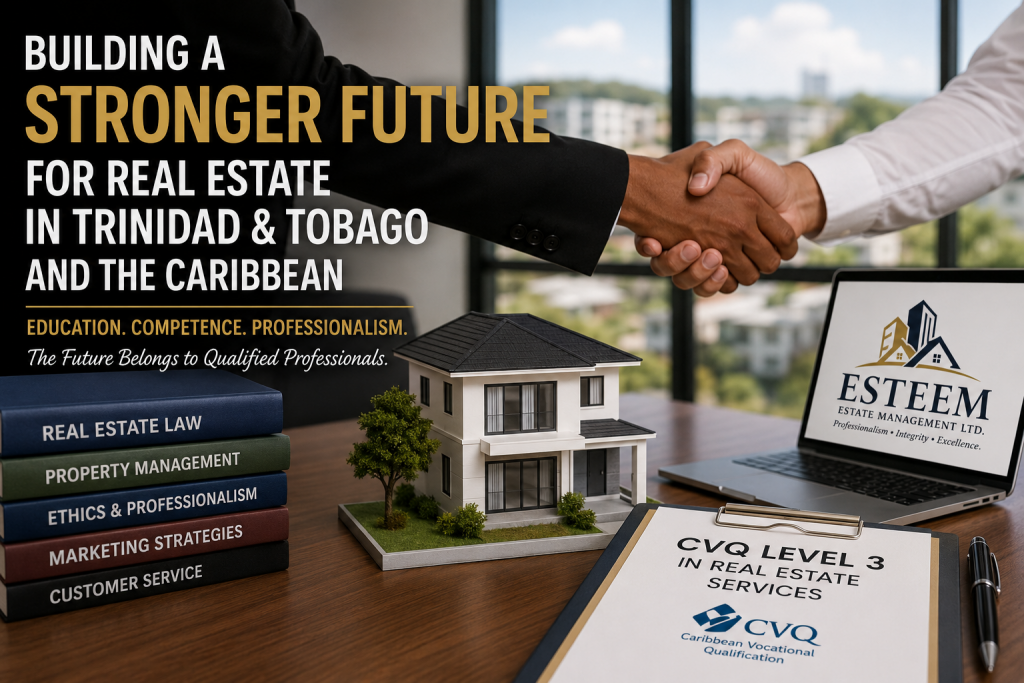
It is with immense pride that Esteem Estate Management Ltd. has become the first institution in Trinidad and Tobago to offer the CVQ Level 3 in Real Estate Services.
This achievement represents far more than the introduction of another course.
It reflects our commitment to transforming the real estate profession through structured education, competency-based assessment and lifelong professional development.
For over eighteen years, my work in education has reinforced one fundamental belief:
Education changes industries.
When individuals receive quality training, they make better decisions.
They provide better service.
They inspire greater public confidence.
Ultimately, they help elevate the profession itself.
What This Means for Your Career
Whether you are:
- entering the real estate industry,
- already working as an agent,
- employed within a real estate agency,
- managing property portfolios,
- or seeking career advancement,
the CVQ Level 3 in Real Estate Services offers more than a certificate.
It demonstrates that your knowledge and practical competencies have been assessed against recognised occupational standards.
It enhances your professional credibility.
It strengthens your confidence.
It improves employability.
It supports career progression.
Most importantly, it positions you to deliver a higher standard of service to every client you represent.
Looking Ahead
The future of Trinidad and Tobago’s real estate industry will not be shaped solely by market conditions or property prices.
It will be shaped by the calibre of its professionals.
As our industry continues to evolve, education must become the foundation upon which professionalism is built.
At Esteem Estate Management Ltd., we are proud to be contributing to that future.
Because when we invest in people, we strengthen businesses.
When we strengthen businesses, we build industries.
And when we build industries on competence, ethics and excellence, we create lasting value for our country and the wider Caribbean.
The future of real estate belongs to qualified professionals.